
The Motherboard
What is a motherboard?

The motherboard is the main circuit board of a computer that links all other components together.
Components can communicate by sending signals and data across pathways called buses.
Some components, like the CPU and RAM, are directly installed in special sockets on the motherboard.
There are expansion slots for further components like a graphics card.


What is connected to the motherboard?


Central Processing Unit
Random Access Memory
Graphics Processing Unit

Read Only Memory


.png)
Cache Memory
Sound Card
Hard Disk Drive
Power Supply Unit
What is a motherboard's form factor?
Form factor relates to the motherboard's size, shape and how many components it can fit. The three most common form factors are compared below:

ATX
Micro ATX
Mini ITX
Standard
Small
Very Small
32 GB
64 GB
128 GB
7
4
1
Size
Max RAM
Expansion Card Slots
GB stands for gigabytes
What ports does a motherboard have?
The motherboard contains several ports on the back panel, allowing cables to be connected to input or output data. Below are some of the common ports:

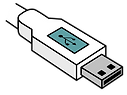



USB (Type-A)
Connects input devices like keyboards and mice or storage devices like a USB memory stick.
USB (Type-C)
A newer type of USB that is faster and commonly used to charge devices or transfer data.
Ethernet
Allows a device to connect to a wired network, most commonly to a router, for internet access.

HDMI
Connects to a monitor or TV to show the computer's audio and visual output.